

Facing Uncertainty on the Industrial Frontline, JX Intelligence Builds Executable Embodied Intelligence Capabilities
Abstract: Industrial sites are constantly changing. How can robots understand the environment, assess risks, and complete tasks? With JX-Phi Brain at its core, JX Intelligence presents a product design approach spanning from environmental perception to task operation, from multi-embodiment adaptation to air-ground collaboration.
On an industrial site, a single inspection tour may require autonomously planning a route to bypass work vehicles and avoid fallen objects at the edge of passageways; upon reaching the equipment, the robot must also locate the operating target and complete specific operations.
If communication is interrupted along the way, how should the task continue?
These concrete problems form the design starting point for JX Intelligence's embodied intelligence products.
Centered on navigation, manipulation, emergency response and collaboration for industrial environments, a series of task demonstrations illustrate a product paradigm built around JX‑Phi Brain — the General Cross‑Embodiment Physical AI Brain. It connects environmental understanding with task execution, enabling robots of diverse forms to perform work according to field requirements.
How Does One Brain Adapt to Different Bodies
Robots of multiple forms appear one after another: there are drones, quadruped robots, and humanoid robots; there are operating platforms equipped with robotic arms, and robots carrying water cannons.
Different forms correspond to different task requirements. Entering complex spaces requires considering the mode of passage; operating cabinets requires a robotic arm capable of approaching and manipulating the target; firefighting operations require carrying the corresponding execution tools.
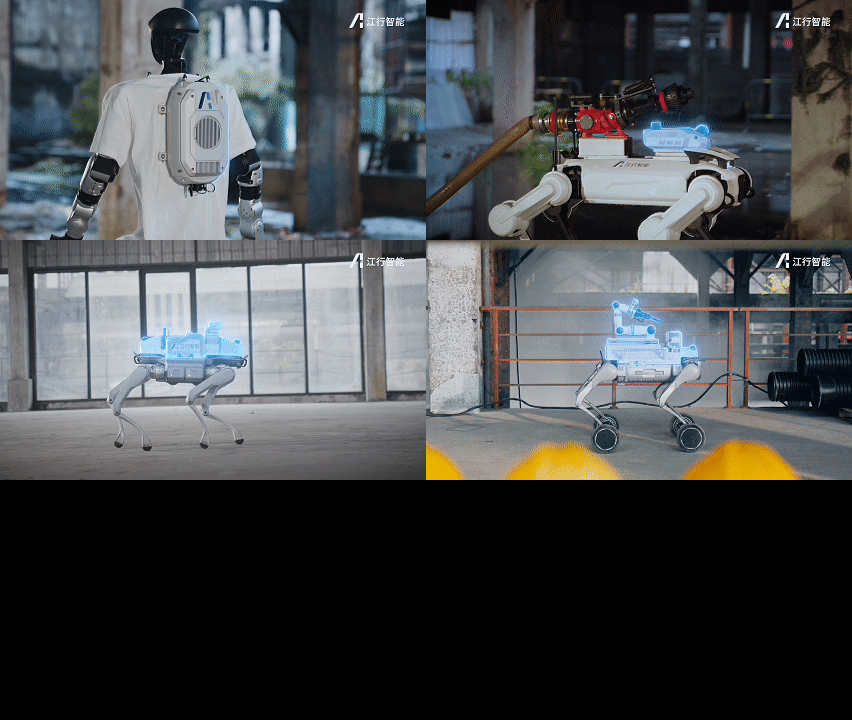
With JX-Phi Brain at the core, connecting environmental understanding with robot action
JX Intelligence unifies these products under one design thread: configuring robot embodiments for given tasks, while a shared brain delivers all intelligent capabilities.
Five capabilities are used to describe JX-Phi Brain: seeing the world, understanding space, assessing risk, identifying targets, and acting autonomously. From acquiring environmental information, to determining what to do next, to driving the robot to execute, these capabilities together serve on-site tasks.
The design significance of "one brain, multiple bodies" unfolds from this: enabling environmental understanding and task decision-making capabilities to be adapted across different embodiments, and returning the choice of body and tools to specific operational needs.
Let Environmental Perception Influence Every Action
For a robot entering an industrial site, after identifying an object, it must also judge its relationship to the current task: Does it affect passage? Is there a risk nearby? Is the original route still appropriate?
We unfold this step of the design through point cloud perception, AI recognition, and environmental parsing visuals.
During dynamic operations, the robot adjusts its travel route based on risk assessment
Near a moving work vehicle, the robot perceives the surrounding environment and plans a detour path. In another passage demonstration, the visuals mark fallen objects at the edge of the passageway, and the robot adjusts its route accordingly to bypass them.
During the passage demonstration, the robot adjusts its travel route based on risk assessment
These two scenarios illustrate the same design requirement: perception results need to enter the decision-making process and change the robot's next action.
Therefore, path planning must continuously incorporate on-site conditions. Task objectives can remain consistent, while the way of reaching the target should be adjusted as the environment changes. Connecting spatial understanding, risk assessment, and movement execution is an important foundation for robots to cope with changes on industrial sites.
From Finding the Target to Completing Specific Operations
When the robot reaches the equipment, the next issue to solve is how to interact with it.
Cabinet operation presents a clear chain of actions: identify the cabinet, locate the knob, and the robotic arm approaches the target and performs the operation.
A seemingly simple action connects capabilities at different levels. The robot needs to determine the operating target, find its specific position, and then translate judgment into action through the execution tool. Only when these links connect with one another can environmental perception further serve operations.
This is also the concrete embodiment of JX Intelligence connecting the "brain" and the "body" in product design: the brain understands the task and the object, while the body interacts with the physical world through appropriate execution mechanisms.
From identifying the cabinet and locating the knob to the robotic arm performing the operation
When the task changes, the execution tool changes accordingly. In the event of a fire, the robot equipped with a water cannon will identify the direction of the fire source and carry out water-spraying operations.
Demonstration of a robot equipped with a water cannon carrying out firefighting operations
Cabinet operation and water cannon operation have different action requirements, yet both point to the same design principle: select the body and tools according to the task, so that intelligence capabilities have an appropriate means of execution.
For work requiring personnel to approach risk sources, this design also offers a product exploration direction: letting robots take on the corresponding approach and operation tasks, reducing the need for personnel to be directly exposed to hazardous environments.
When Communication Changes, How Does Collaboration Pick Up the Task
When the screen indicates signal loss, the ground robot issues a collaboration request. The drone takes off to establish a signal relay, and the ground task then continues — we extend the focus of product design to the conditions for task execution.
For a robot to complete work, it needs to be able to pass through, perceive, and operate, and it also needs the communication conditions required by the task. When communication changes, how the system discovers the problem, invokes collaborative capabilities, and creates conditions for the task to continue must also be incorporated into the design.
In the air-ground collaboration demonstration, the drone provides a signal relay to support the continuation of the ground task
In this scenario, the ground robot and the drone each have their roles: the former undertakes on-site tasks, while the latter provides an aerial signal relay. The value of collaboration is reflected in whether it can supply the required capability for the task being executed.
Returning Product Design to On-Site Results
From bypassing work vehicles to avoiding edge risks; from cabinet operation to carrying tools for operations; from single-machine action to relying on drones to continue communication, all scenarios point to one design path: centering on on-site tasks, connecting perception, judgment, action, and collaboration.
With JX-Phi Brain at its core, JX Intelligence is advancing embodied intelligence product design around these issues, letting the capabilities of different embodiments serve specific tasks.
The product presentation ends here, and everything we have shown finally condenses into one sentence:
Let physical AI execute reliably in the real world.