

"Physical AI Has No Shortcuts" — Three Observations Made by Pang Haitian at the World Robot Conference
On August 21, during the 2026 World Robot Conference (WRC), the Embodied Intelligence Commercial Implementation Forum, hosted by EqualOcean, was held in Beijing.
As one of the core sub‑forums of the World Robot Conference, this event brought together top‑tier scholars, industry leaders and investment institutions from the global embodied‑intelligence sector. Centering on the core industry challenge of advanced technical maturity lagging behind commercial roll‑out, participants explored critical pathways for embodied intelligence to move from laboratory research toward industrial‑scale application.
Pang Haitian, Chairman and CEO of Jiangxing Intelligence, delivered a keynote speech titled One Brain, Multiple Bodies: The Road to Industrial Deployment of Physical AI, putting forward three key insights on the industrial implementation of Physical AI.
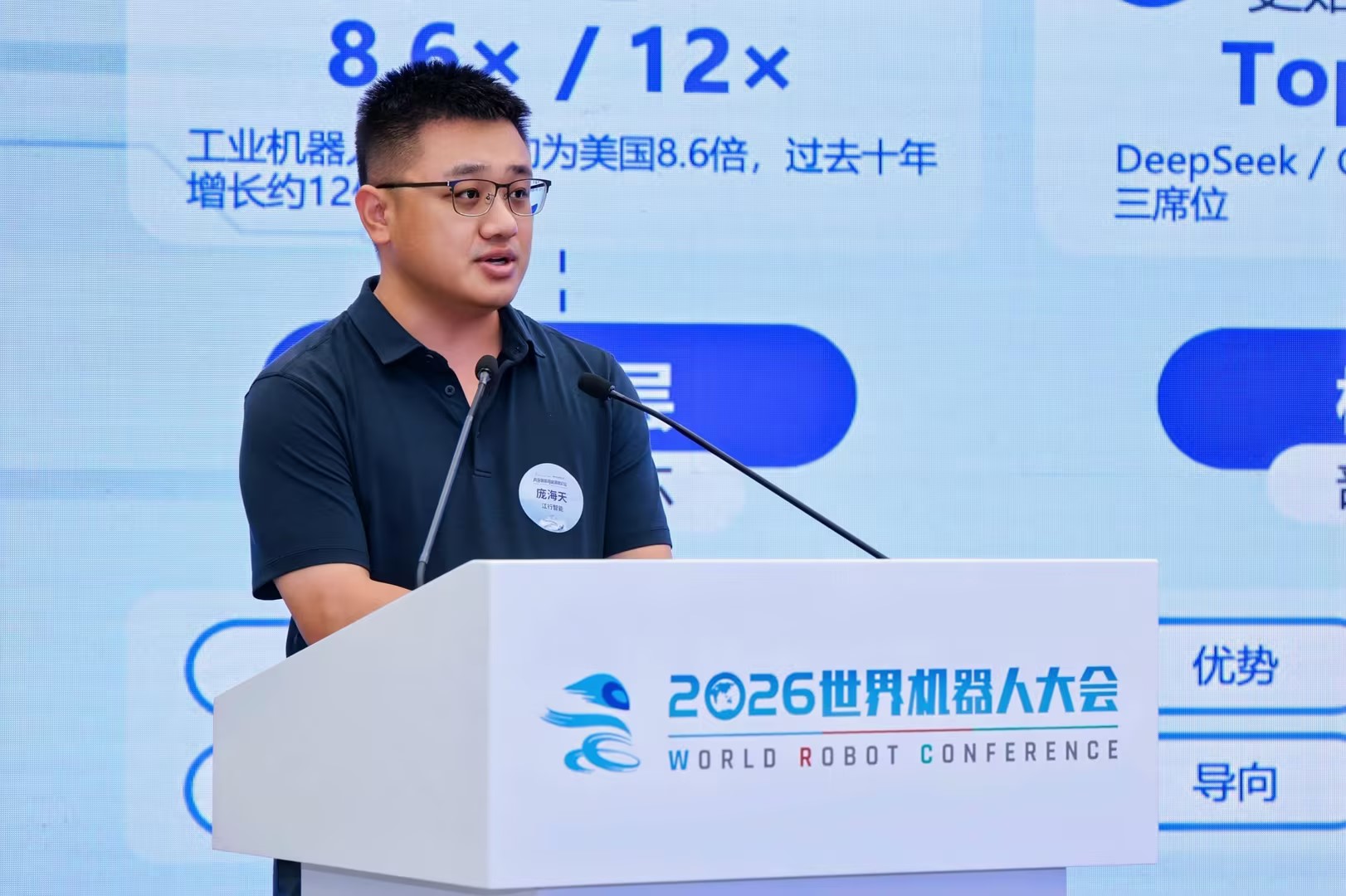
Pang Haitian, Chairman & CEO of Jiangxing Intelligence, delivers the keynote speech
Insight 1: AI Competition Is Shifting From Models to Physical Systems
Large‑language models have proven their value in the digital world. However, according to Pang Haitian, genuine new‑growth opportunities lie beyond the digital realm: enabling AI to step into real‑world industrial sites, perceive its surroundings, connect with equipment, execute tasks, and iterate continuously from real‑time operational feedback.
This follows a fundamentally different logic from digital‑based AI. Digital‑world AI competes on model parameters, training computing power and dataset scale. Physical AI competes on a different capability: the ability to deploy artificial intelligence into the real‑world physical environment in a stable, controllable and cost‑effective manner.
“Generative AI mainly generates content within digital space. By contrast, Physical AI needs to enter live industrial sites, understand environments, interface with equipment, carry out tasks, and achieve iteration through continuous feedback,” Pang Haitian noted.
In his view, China holds unique competitive advantages on the Physical‑AI track: high‑density industrial scenarios, a complete industrial‑chain foundation, and multi‑layer coordinated support spanning models, infrastructure and energy resources. These factors mean that China’s Physical‑AI deployment path will not simply copy models adopted in other countries.
Insight 2: Industrial Scenarios Do Not Demand Smarter Robots, but a Reliable Closed‑Loop System
This section contains the most technically advanced arguments of the speech.
Pang Haitian pointed out that the mainstream industry approach today focuses on pushing the upper performance limits of models — larger parameter sizes, extended context windows and more sophisticated reasoning chains. Industrial operations, however, attach far greater importance to stable model performance and are extremely sensitive to failure risks.
“Industrial scenarios have an ultra‑low fault‑tolerance threshold. Once probabilistic outputs from an AI model go wrong, production accidents may be triggered,” he explained.
Jiangxing Intelligence’s solution is to build the Harness Constraint Mechanism. Simply put, it converts industrial operational regulations into semantic constraints for AI models — essentially putting a “rein” on large models to define clear execution boundaries for robots. Any action beyond these preset limits will be prohibited.
Underpinning this mechanism is a core viewpoint: the reliability of Physical AI cannot be guaranteed solely by the model’s native capabilities, and must be backed up by system‑level constraints. Harness enables one‑brain multi‑body control and industrial‑rule‑based constraint enforcement.
The system now supports access to more than one hundred types of industrial equipment and facilitates collaborative operation of diverse heterogeneous robots within plant sites. Having moved past laboratory proof‑of‑concept validation, this mature solution has been deployed across over one‑thousand industrial stations.
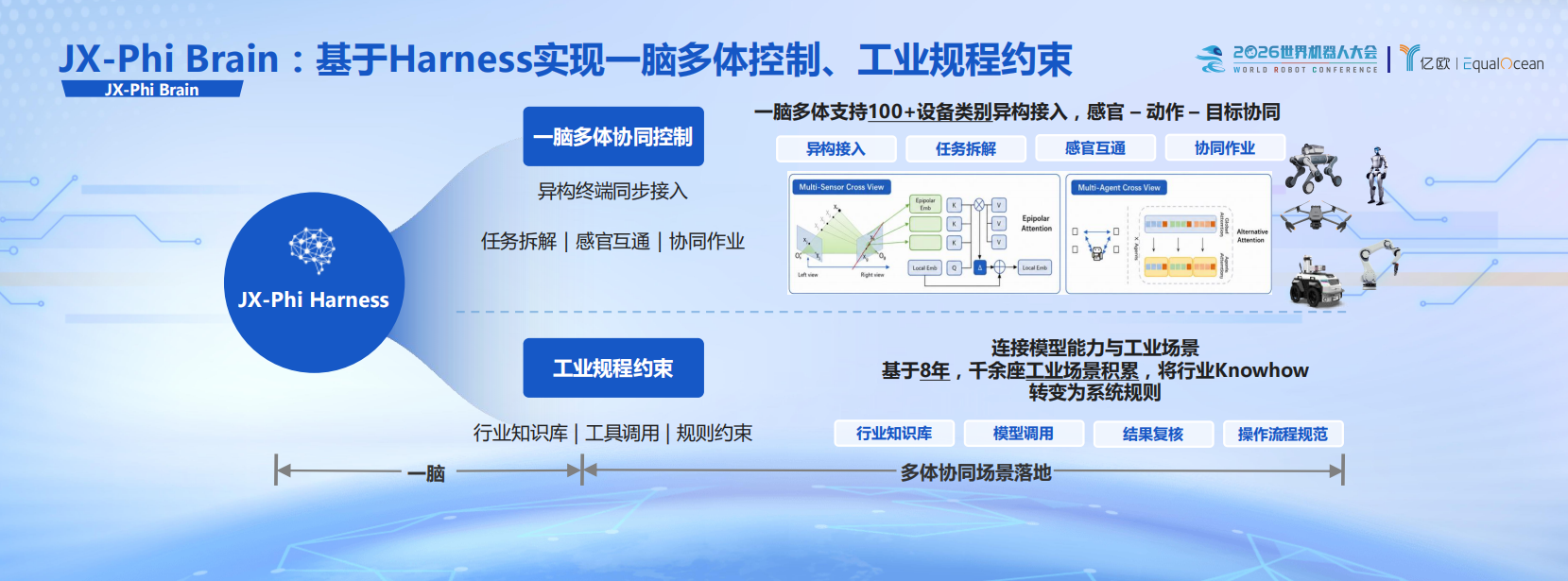
One‑Brain‑Multi‑Body Control and Industrial‑Regulation Constraints Enabled by Harness
Insight 3: Physical AI Is Not Trained in Laboratories — It Is Forged On‑Site
This was the most‑repeated statement throughout Pang Haitian’s speech.
“The gap between competitors does not stem from a single algorithm, but from the real‑world years spent operating and maturing the data flywheel.”
The physical‑interaction data required for Physical AI — contact, friction, gravity, object deformation, equipment ageing and environmental changes — can only be obtained through interaction within real‑world physical environments. Simulation data can serve as an auxiliary resource, yet it cannot replace the nourishment of authentic field data.
Jiangxing Intelligence has built its expertise across more than 1,000 industrial stations covering power grids, new‑energy facilities and other scenarios, spread across 27 provinces, municipalities and autonomous regions nationwide. Every robot deployed at these stations and the industrial experience generated from each inspection mission feeds into the unified data foundation to fuel continuous model iteration.
Supporting this whole ecosystem is the Data‑Acquisition and Computing Center of Jiangxing Intelligence, located in Gui’an New Area, Guizhou Province. Leveraging its strategic position within the national East‑Data‑West‑Computing hub, Jiangxing Intelligence has established a complete iteration closed‑loop: on‑site data collection → model training in Gui’an → nationwide deployment.
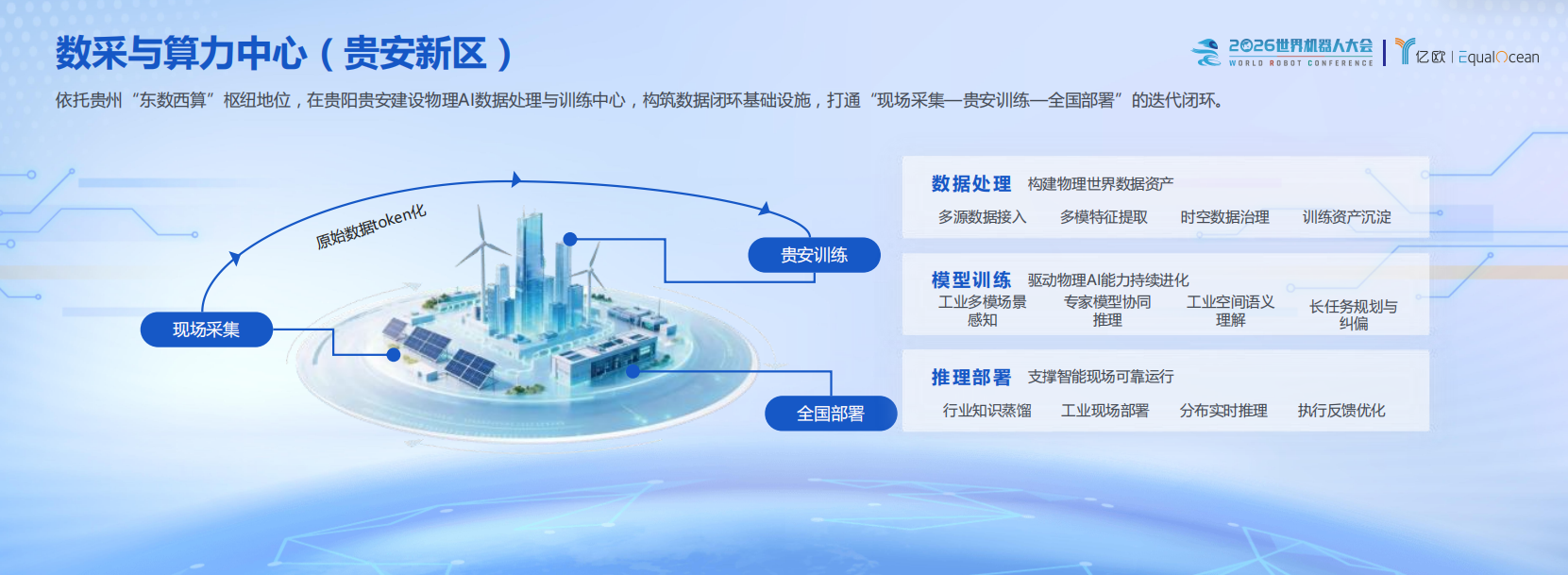
Jiangxing Intelligence Data‑Acquisition & Computing Center (Gui’an New Area)
The outcomes delivered by this closed‑loop framework have been fully validated within the power and new‑energy industries. In the power sector, Jiangxing’s solutions support routine autonomous inspection for a large number of substations, greatly improving operation‑and‑maintenance efficiency and centralized management. Within the new‑energy sector, numerous wind‑power and photovoltaic stations have achieved long‑term stable operation using this system, effectively cutting on‑site manpower requirements and O&M costs while significantly boosting labour productivity.
“Every step of progress for Physical AI must be solidly taken in the real world,” he commented.
These three insights correspond to three strategic choices: compete not within the digital world, but step into the physical world; chase not the upper performance ceiling of models, but a reliably‑operating closed‑loop system; trust not lab‑based demos, but data accumulated from real‑world field deployment.
At the close of his speech, Pang Haitian stated that the ultimate goal of Physical AI — a truly general‑purpose world model — remains far from realization, and the whole industry is still climbing uphill. Nevertheless, a pragmatic, scalable and sustainably‑iterative development pathway has already been validated in industrial field deployments.
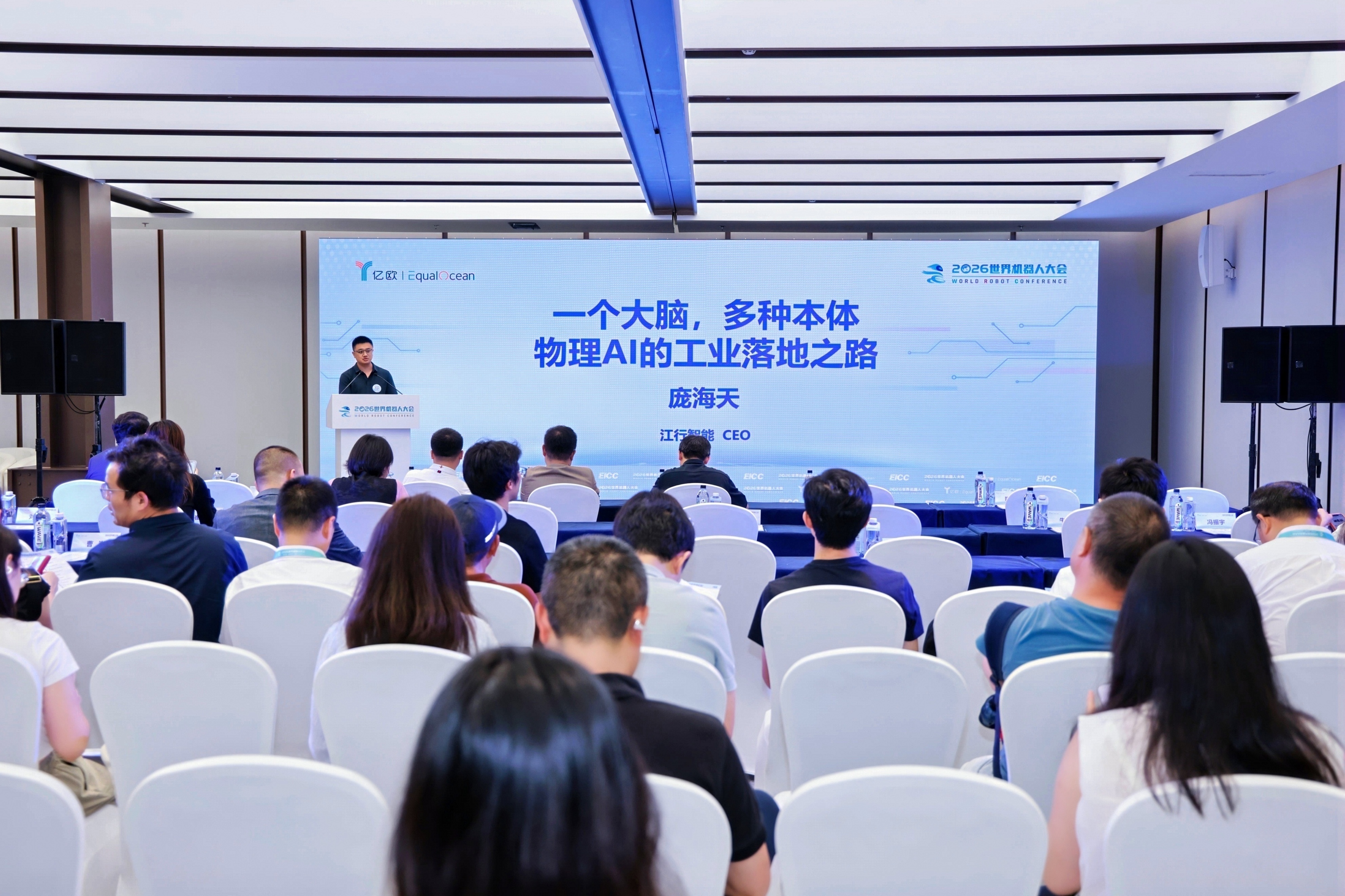
Pang Haitian, Chairman & CEO of Jiangxing Intelligence, delivers his on‑site speech
There are no shortcuts along this journey, yet every single step counts.