

Toruk Accepted for Oral Presentation at ACM Multimedia 2026: Jiangxing Intelligence Advances Interactive Access to Reconstructed 3D Environments
3D reconstruction enables increasingly photorealistic digital representations of the physical world. But once a city, campus or industrial facility has been reconstructed, can users access it over a network whenever they need to, freely examine their surroundings and continue exploring without interruption?
High-fidelity scene representations provide a foundation for remote collaboration, reviews of industrial site operations and virtual training exercises. As scenes grow larger, practical applications must address a critical challenge: delivering the right content at the right time under changing network conditions while maintaining a continuous viewing and interaction experience.
A paper co-authored by researchers from Nankai University, Jiangxing Intelligence and other institutions, “Toruk: Spatially Adaptive Large-Scale 3DGS Scene Streaming for Photorealistic Interactive Virtual Walkthrough,” has been accepted for oral presentation at ACM Multimedia 2026.
The research introduces Toruk, a spatially adaptive streaming system that jointly designs scene representations, content prefetching and transmission decisions. It explores how to enable high-fidelity interaction with large-scale reconstructed environments over dynamic networks, providing a technical foundation for broader use of real-world environment data.
Moving from reconstructing a space to making it continuously usable requires more than better visual quality. It also demands coordinated solutions for data organization, network delivery and interactive responsiveness.
Making Reconstructed Environments Usable
Recent advances in 3D Gaussian Splatting(3DGS) have enabled high-fidelity reconstruction of real-world environments.
3DGS represents an environment using large numbers of Gaussian primitives, each with attributes such as position, shape, color and opacity. This allows users to examine detailed scenes from different positions and viewing angles. However, as reconstruction expands from individual objects to entire areas, data volumes increase rapidly.
Even after compression, large-scale 3D scenes can occupy gigabytes of data. Requiring users to download an entire model before accessing it delays the start of remote interaction. Loading only what is currently visible, meanwhile, may leave the system unprepared for the user’s next movement. An engineer remotely inspecting an industrial facility, for example, might first examine the overall layout, then move along a passage into an equipment area before turning to inspect the surroundings.
As the viewpoint changes, so do the extent and level of detail of the required data. Conventional video follows a fixed timeline, allowing systems to buffer the next few seconds in advance. In a 3D walkthrough, the user determines the viewing sequence. Moving forward, turning, pausing or retracing a route changes what data is needed next.
High-quality 3D interaction therefore requires scene content to arrive in step with the user’s movements. How a scene is partitioned, which regions are prefetched and how limited bandwidth is allocated all directly affect the experience.
Toruk addresses these interconnected challenges.
Organizing Space for Partitioned, Layered and On-Demand Access
Preparing a 3D scene for network delivery begins with data organization. An intuitive approach is to divide the scene into smaller regions and load them on demand. However, Gaussian primitives jointly contribute to image rendering. Partitioning them solely by spatial position can introduce boundary artifacts and disrupt visual consistency. Simply reducing the number of primitives also makes it difficult to balance data size against image quality.
Toruk addresses this through a local–global crossed 3DGS segmentation and layering representation. The system partitions the scene into spatial units using capture trajectories and scene geometry. A coarse global representation provides a structural reference, while alternating local optimization and global fine-tuning produces a base layer and enhancement layers for each region.
The base layer provides essential visual content, while enhancement layers progressively add detail. Different regions can be rendered at different quality levels while contributing to a complete image.
This structure allows transmission to follow viewing needs: distant regions can first receive basic content, while nearby regions progressively receive finer details, with visual consistency maintained across regions. Large reconstructions thus become spatial content that can be retrieved incrementally.
For extensive real-world datasets containing many regions, this approach provides a more flexible foundation for remote access and repeated use.
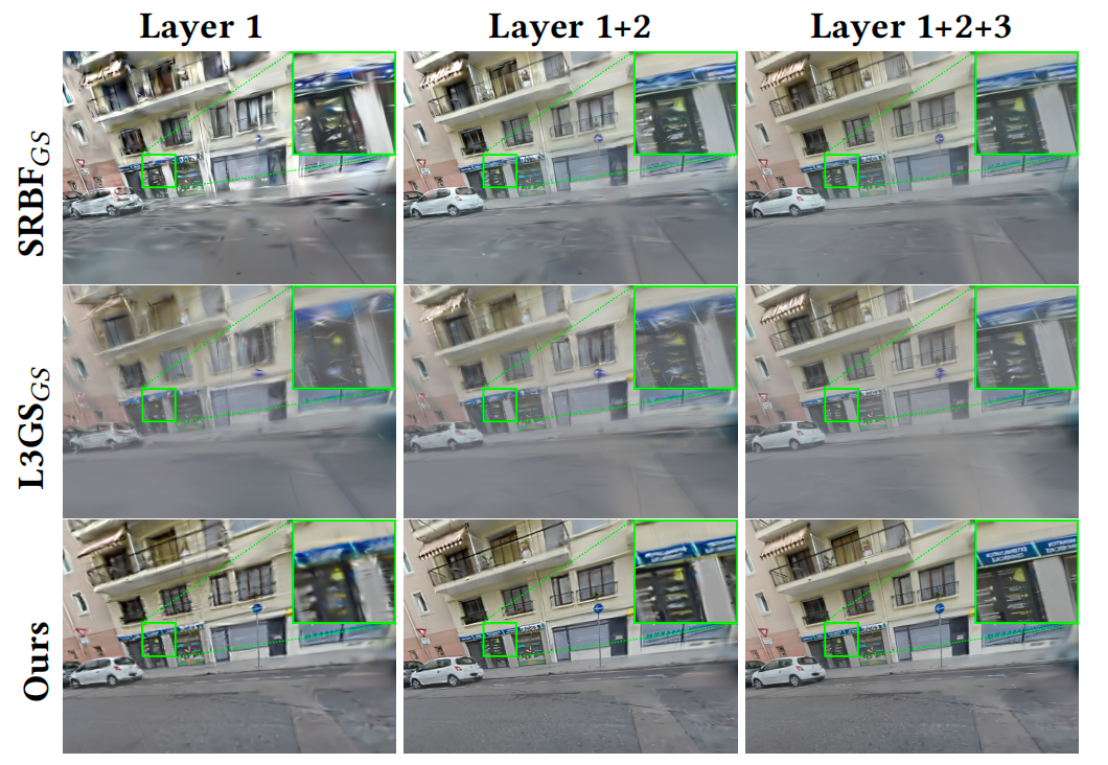
Example of layered scene representations
Prefetching the Right Content Despite Viewpoint Prediction Errors
Accurately predicting a user’s future position and orientation in 3D space is difficult. Uncertainty generally increases with the prediction horizon. The researchers nevertheless observed that an inaccurate position prediction does not necessarily lead to incorrect content prefetching.
For example, two slightly different predicted positions along the same road may still require the same set of spatial units. Road layouts, corners and occlusions also constrain where users can move and what they can see.
Building on this observation, Toruk introduces a scene-aware viewport prediction pipeline. The system converts predictions across a range of positional and orientation errors into prefetching weights. It then evaluates the visual importance of each spatial unit using inter-region occlusion, viewing distance and the proportion of the viewport it occupies.
The objective is to determine which regions are likely to become visible, how much they will contribute to the rendered image and which content should be prepared in advance.
This design connects viewpoint prediction more directly to actual delivery requirements, using scene geometry as an important input to content prefetching.
Industrial environments also contain strong spatial constraints. Passages connect equipment areas, buildings create occlusions and inspection routes often follow recurring patterns. Future work could incorporate task routes and regions of interest into workflow-aware scene preloading, aligning content delivery more closely with operational needs.
Continuously Scheduling Content for Current and Future Views
A further challenge in 3D walkthroughs is that the amount of cached data does not directly determine how long smooth viewing can continue. If a user pauses to examine an area, cached content may remain sufficient for an extended period. If the user moves quickly or turns abruptly, new content may be needed immediately.
The paper calls this behavior-dependent cache “Schrödinger’s buffer”: its effective duration depends on the user’s future actions.
Toruk handles base-layer and enhancement-layer requirements separately. It prefetches essential content for new regions in advance, while scheduling enhancement layers over a shorter prediction horizon.
The system also introduces a cross-temporal and inter-spatial causal sequence model. Drawing on historical states, transmission actions, available bandwidth and buffer conditions, the model selects enhancement-layer requests for different regions. It dynamically allocates resources between the quality of the current view and the needs of subsequent exploration.
When users stop to examine a region, delivering additional detail offers greater value. When they continue moving, the system must reserve transmission capacity for the scene ahead.
Continuous adjustment coordinates scene representation, content prefetching and network scheduling. Data is organized spatially, prepared according to anticipated viewing behavior and delivered progressively as network conditions allow.
Improving Interaction Across Large Scenes and Dynamic Networks
The team implemented an end-to-end prototype in Unity and evaluated it using two environments: SmallCity, an urban scene covering approximately 40,000 m², and Campus, a campus scene covering approximately 55,000 m².
The evaluation replayed real-world network throughput traces from fixed broadband and 5G connections to test performance across different scenes, user behaviors and network conditions.
The paper reports the following average improvements:
● A 2.2 dB increase in peak signal-to-noise ratio(PSNR), indicating improved reconstruction quality.
● A 67.5% reduction in download timeout penalty, indicating less degradation caused by enhancement content arriving late.
● A 36.3% improvement in quality of experience(QoE), reflecting a better balance between visual quality and transmission efficiency.
These results show that jointly optimizing scene representations, content prefetching and transmission strategies can improve interaction with large-scale reconstructed environments under dynamic network conditions.
The usability of a 3D scene depends both on the clarity of its representation and on whether the required spatial content arrives in time.
Turning Reconstructed Environments into Reusable Data Assets
For Physical AI, real-world environment data captures essential information about equipment layouts, spatial relationships and operating conditions. Preserving this information in 3D provides a foundation for examining environments, reviewing task execution and conducting virtual simulations.
As scene assets accumulate, data infrastructure must also ensure that they remain usable across locations and network conditions.
Jiangxing Intelligence’s JX-Phi World brings together data from real-world industrial environments, robot operations at the edge and virtual simulations to support continuous learning and iteration of Physical AI models. Within this infrastructure, AutoWorld supports environment generation through real-world scene reconstruction and simulation, while AutoEdge connects industrial sites with cloud computing resources.
Once captured environments have been digitized, their data still needs to be organized, delivered and used effectively to support a wider range of activities. Toruk explores one specific part of this process: delivering large-scale spatial content.
Every stage—from real-world data capture and 3D reconstruction to networked interaction and scene reuse—affects the value that environment data can provide. Toruk advances a key step by enabling 3D representations of the physical world to respond to interactive demands, supporting continuous access, detailed examination and practical use.
Jiangxing Intelligence will continue its research into world models, spatial intelligence and supporting infrastructure, enabling real-world environment data to better support model learning and application iteration, and contributing to reliable Physical AI execution in the real world.
Paper
Toruk: Spatially Adaptive Large-Scale 3DGS Scene Streaming for Photorealistic Interactive Virtual Walkthrough
Conference
ACM Multimedia 2026 — Oral Presentation
Authors
Jianxin Shi, Tianshun Cai, Sijie Zhou, Xiaoyi Fan, Cong Zhang, Danyang Song, Yuan Zhang, Lingjun Pu and Jiangchuan Liu