

Why did Jiangxing Intelligence dare to have the audience watch the robotic dog throughout the entire video in one continuous shot?
What's the biggest fear when it comes to robot demonstrations?
It's not that the action isn't exciting enough; rather, the camera doesn't dare stay on location for too long.
When the camera captures every movement, it becomes difficult for the audience to determine whether the action was performed autonomously or if someone intervened from behind; while the robot appears capable of walking, grasping, and recognizing objects, it remains challenging to verify whether it can actually complete a real-world task from start to finish.
As a result, at the Jiangxing Intelligent Technology Exhibition booth during the 2026 China Big Data Expo, a demonstration was presented on-site:
No editing, no staged shots – live streaming throughout.
Within a central circular area that closely replicates an industrial operational site, the Qingxun X1U – equipped with the JX-Phi Brain physical AI brain – autonomously rises from its charging pad, sequentially performs positioning, navigation, obstacle avoidance, device operation, intelligent inspection, and multi-robot coordination tasks, before finally returning to the charging pad for autonomous recharging.
The entire process takes approximately three minutes.
Dozens of audience members watched the live broadcast, trying to pinpoint the moment when the camera was switched or when the operation was manually taken over.
However, what this demonstration is truly intended to demonstrate is not how many movements a robotic dog can perform, but something else: whether the robotic system can still complete its tasks reliably when the tasks become longer, the environments more complex, or the number of devices increased.
1. Upon rising from the charging pad, the robot must first demonstrate its ability to "accept tasks."
The demonstration has begun; the backend is issuing inspection tasks.
The X1U, lying on the charging pad, autonomously rose and entered mission mode, completing on-site positioning before initiating route planning. The pillar ahead simulated an obstacle found in an industrial environment; upon detecting it, the X1U did not simply crash straight into it but instead autonomously adjusted its path to detour around it.
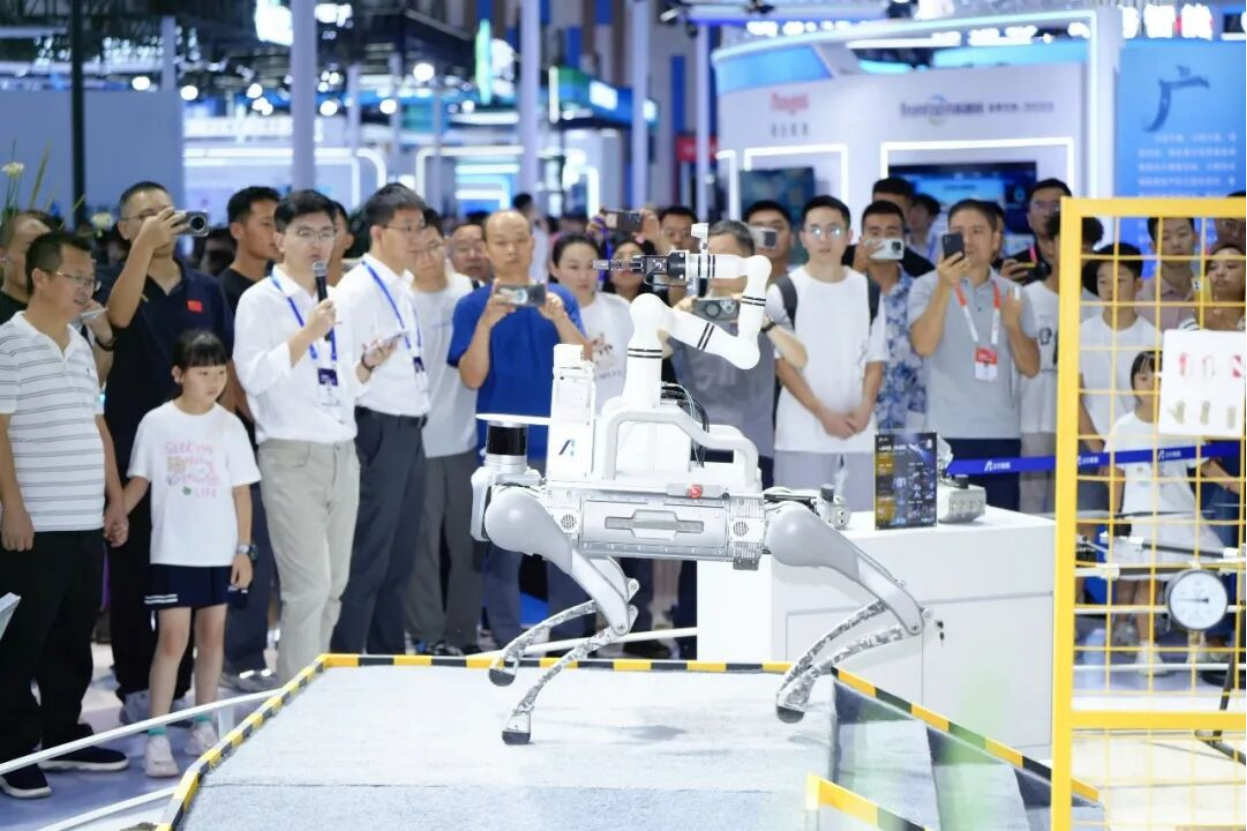
This step may seem straightforward, but it marks the starting point of the entire demonstration.
From this point onward, the "remote control" is no longer in use.
The task is issued from the backend, while the route is determined by the robot. The robot is no longer merely executing a pre-written sequence of actions; instead, it must dynamically decide its next step in real time based on the task objectives and the on-site environment.
This represents the first distinction between physical AI and traditional automation systems: the former deals with specific tasks, whereas the latter primarily responds to instructions.
II. Stairs, ramps, and gravel roads – what is truly tested is continuity.
In real-world industrial settings, robots are never greeted with a smooth red carpet.
Next, the X1U traverses stairs, slopes, and gravel roads, simulating the common elevation changes, slopes, and unstructured road surfaces found in industrial environments.
What is most noteworthy here is not the various terrains it has traversed, but rather how these terrains are connected into a continuous route.
The robot does not stop at each station to re-prepare, nor does it rely on on-site personnel to transport it to the next location. The quadrupedal platform handles stable mobility, while the JX-Phi Brain continuously determines "where to go" and "how to get there" by integrating the mission objectives with environmental changes.
The body is responsible for movement; the brain is responsible for understanding and decision-making.
Only when these two components are properly meshed together can the robot enter hazardous areas that are difficult for humans to reach—rather than performing a flawless maneuver solely under ideal conditions.
III. When you reach the power distribution cabinet, it's not just about "seeing" it – you should actually handle it with your hands.
What truly drew the live audience closer was the operation performed in front of the power distribution cabinet.
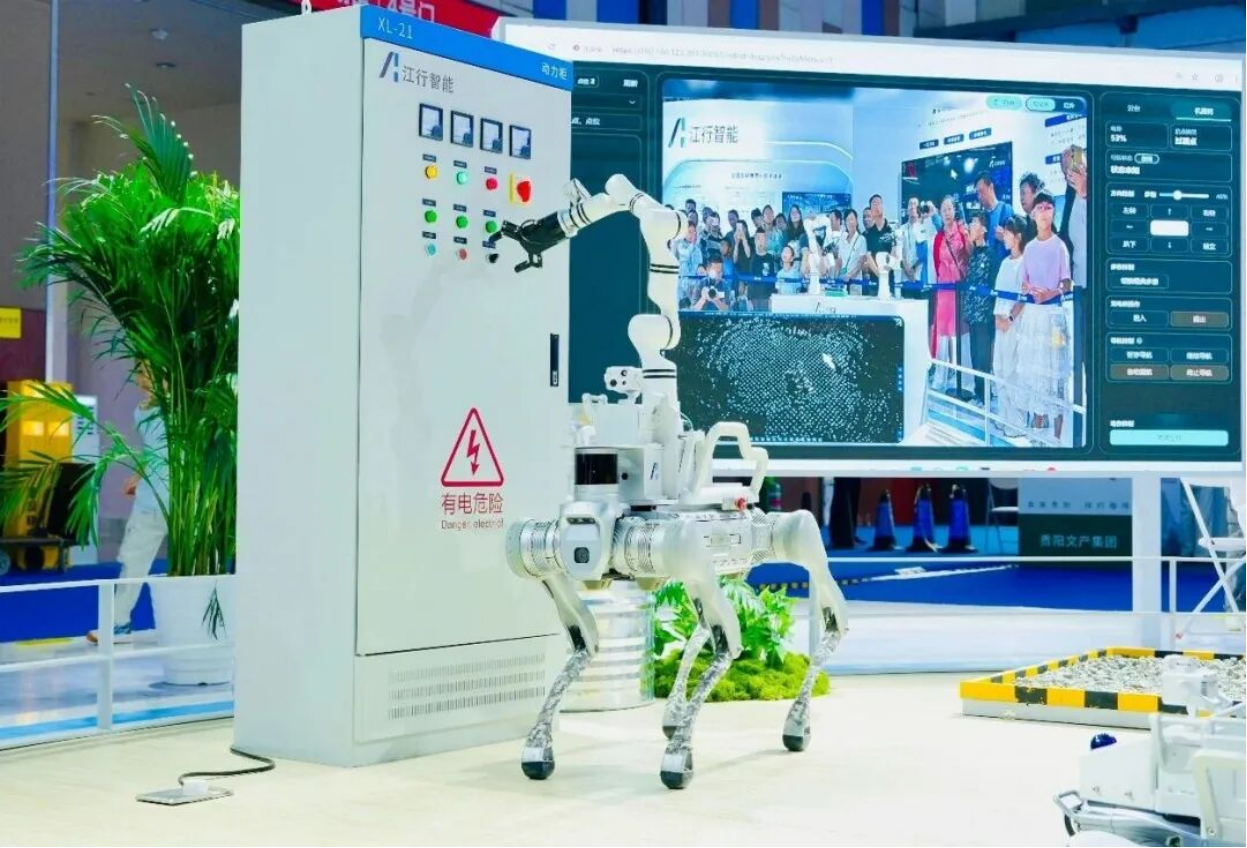
The X1U comes to a stop; the operational robotic arm is extended to locate the target knob and complete its reset. Upon completion of this action, the device will turn its head for a secondary confirmation to verify whether the knob has been successfully reset.
This marks the shift in the boundaries of robotic capabilities—from "seeing" and "data collection" to "contact" and "operational tasks."
The transition from identifying a problem to participating in its resolution is not as simple as merely adding a robotic arm; the robot must execute a complete sequence of actions—including target localization, posture adjustment, precise alignment, grasping, and operation confirmation—none of which can be omitted.
In addition to knob-based operation, the X1U also supports common actions such as pressing, pulling, and placing/removing; it can be extended with various end-effectors—such as partial discharge or UV detectors—depending on the task requirements.
In the past, inspection robots were more like mobile eyes; today, they are beginning to serve as a pair of hands on-site.
IV. From metering devices to the Bird's Nest: Smart inspection systems must bring the information back.
Continuing forward, the X1U approaches the yellow iron fence and activates its AI pan-tilt camera, which is then aimed at common power infrastructure inspection targets such as metering devices and the Bird's Nest facility.
Meanwhile, the large adjacent screen displays the inspection footage in real time.
Multi-source sensing capabilities—such as visible light imaging, infrared thermal imaging, and LiDAR—are seamlessly integrated at this station: the system arrives at the target location, identifies the inspection object, and completes the image transmission; the entire process occurs in a continuous sequence.
At this point, the X1U has completed the primary tasks required of an inspection robot.
However, if only a single robot is capable of completing a task independently, this still merely represents a demonstration of "single-machine capability."
The highlight of this demonstration is how the three devices that follow will work together.
V. Big Dog Calls Little Dog: Multiple minds, multiple bodies – it's not about the excitement, but about division of labor.
X1U initiates a collaborative task and notifies Lingxun C1U: "Deliver the voltage tester from the cargo basket to the work area."
Subsequently, a relay sequence emerged on site – seemingly simple, but in reality involving a lengthy chain of events:
The small dog C1U arrives carrying an electric pen; the large dog X1U uses its robotic arm to retrieve the electric pen from the loading basket and moves it to the edge of the table; the tabletop robotic arm then takes over the electric pen and performs a voltage testing operation on the cable; once the voltage testing is complete, the electric pen is precisely returned to the small dog's loading basket.
Take, deliver, inspect, return.
Behind these four actions lies a seamless sequence of operations: target positioning, robotic arm alignment, gripper grasping, posture adjustment, and tool handover. The X1U must both maintain its own stability and control the robotic arm to perform precise tasks; simultaneously, all other devices must execute their respective tasks at the correct time and in the correct position.
This is precisely the essence of the "multiple brain-body" concept.
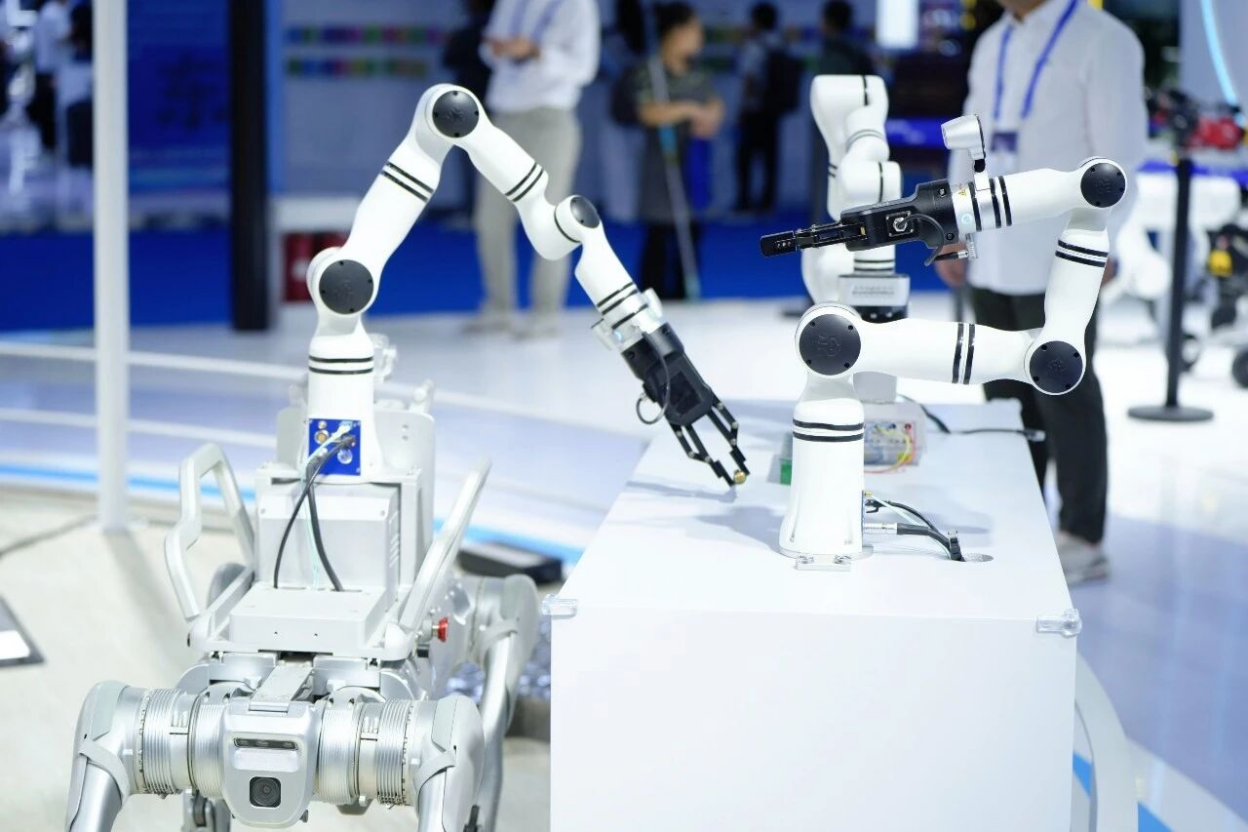
Rather than having multiple devices operate simultaneously to create a lively effect, it first decomposes the task and then assigns it to each device based on its respective capabilities:
The large dog is responsible for mobility and operation; the small dog handles material transportation; and the desktop robotic arm performs inspection tasks.
A single task objective is broken down into multiple steps; multiple robots and terminals collaborate on the same intelligent capability platform.
The tethered drones and gun-style cameras in the exhibition area also share the same set of physical AI capabilities. While the end devices may vary and perform different tasks, the underlying "brain" remains consistent.
This is what distinguishes "Multiple Bodies in a Single Brain" from simple multi-device coordination: it's not about the more devices you have, the smarter the system becomes, but about whether different physical entities can effectively collaborate around a single task.
VI. A puddle reveals whether the robot truly understands the environment or not.
During its journey, the X1U encountered a puddle.
This is a moment that is easily overlooked, yet it speaks volumes.
A conventional robot might simply walk straight through the area—either because it cannot recognize the environment or because it doesn't understand what the area signifies. In contrast, the X1U stops and autonomously chooses an alternative route based on its understanding of the surroundings.
Not only can it detect obstacles, but it can also understand the scene.
This gap represents a more profound divide between physical AI and traditional automation systems: robots are not merely receiving visual signals; they must also convert these perceptual inputs into actionable decisions.
7. Returning home to recharge means the task can enter a cyclical loop.
Upon completion of the task, the X1U autonomously returns to the charging pad for recharging.
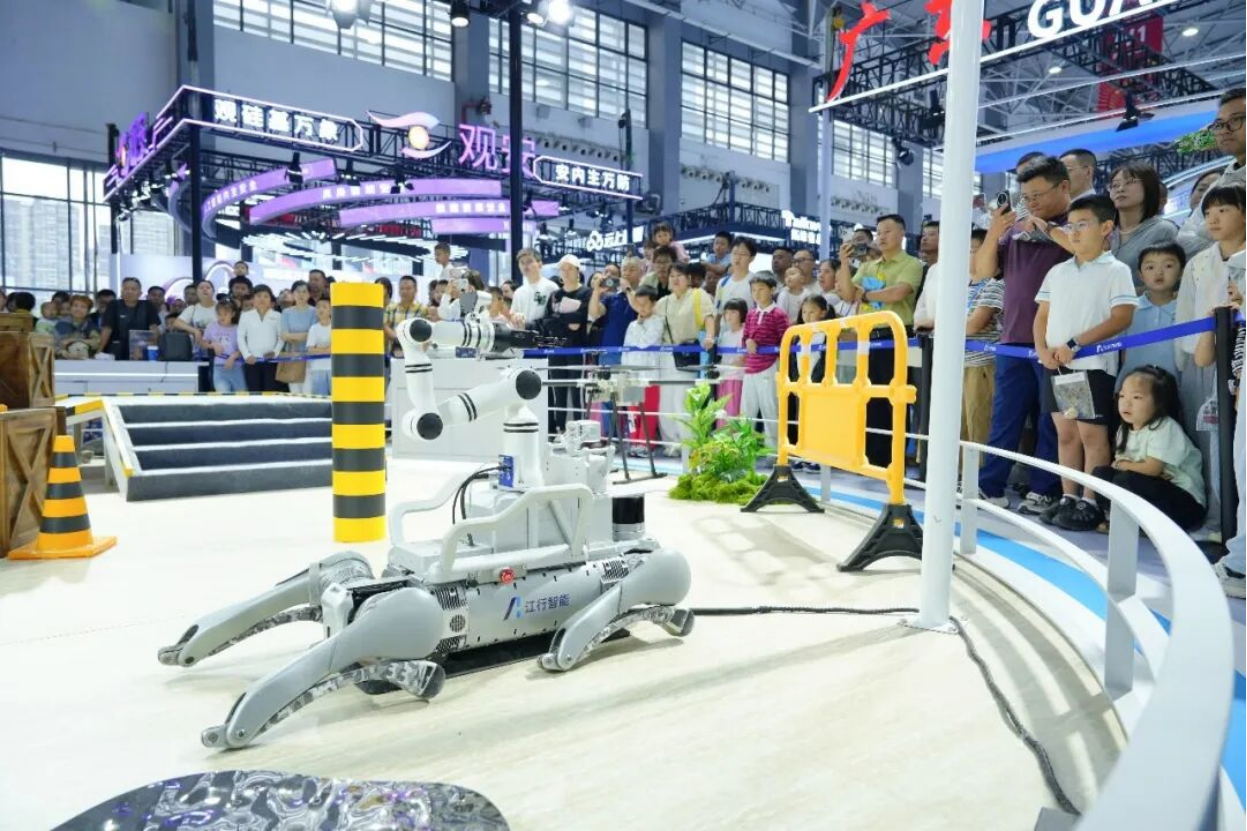
From task delegation, autonomous navigation, traversal of complex terrain, mechanical operations, intelligent inspection, and multi-vehicle coordination all the way to the final autonomous recharging – a complete closed-loop process is seamlessly executed before the audience.
Recharging is not merely the concluding action of the demonstration.
This means the robot operates on a cyclic mechanism of "task completion – autonomous recharging – preparation for the next cycle." In industrial settings, the true value of a robot may not lie in completing a single demonstration, but in its ability to continuously execute the next task without the need for stage lights or re-shooting.
8. Why opt for a single continuous shot? Because each stop does not rely on "on-site coordination."
The answer is actually hidden within this continuous timeline.
The entire demonstration is powered by the JX-Phi Brain – a physical AI brain that connects various robots and terminals through a unified intelligent capabilities foundation, enabling perception, understanding, decision-making, and execution all centered around a single real-world task.
Even when the underlying system is replaced, its capabilities can still be reused; when the task changes, the system can still reorganize its workload.
This is also why a single continuous shot is more persuasive than a meticulously edited sequence:
Short demonstrations are easy; long chains are challenging;
Mastering a single skill is easy; however, mastering the entire process is challenging;
Single-machine performance is straightforward; however, coordinating multiple machines is challenging.
A single continuous shot does not test the camera itself, but rather the system's ability to perform continuous error correction and deliver a stable output across consecutive tasks.
The Big Data Expo has come to an end, but the real-world industrial landscape will not. There are no spotlights or chances for re-shooting – robots must rise on their own, navigate their way, perform their tasks, and return home on their own.
This might be the most honest form of physical AI: not making robots appear as if they "can do things," but enabling them to actually get the job done in the real world.
As robots evolve from simply "seeing" to truly "understanding," and from "single-machine execution" to "multi-robot collaboration," the next critical factor is no longer whether they can complete a single demonstration, but whether they can reliably execute their next task on-site.
Which specific step in the process would you most like the robot to complete for you first?