

What Is the Robotic Dog Thinking Inside the Substation at Minus 20 Degrees Celsius?
Two o’clock in the early morning, a 500kV substation somewhere in Heilongjiang Province. The temperature plummets below minus 20 degrees Celsius; breath condenses into frost the moment it leaves one’s mouth.
In the dead of night when most living creatures lie dormant, amid a forest of towering steel equipment, two faint blue light spots are on the move.
This is the embodied intelligent robotic dog developed by JX Intelligence. It has no fur for thermal insulation and no blood prone to freezing, yet it carries out a mission brooking no error: conducting full-area substation patrols in place of human workers amid the dual hazards of frigid cold and high voltage.
If the robotic dog had an inner monologue, what calculations would race through its system right now?
Build a Warmer World Than Humans Perceive
For human patrol inspectors, minus 20°C means wrapping themselves in three layers of cotton-padded coats, facing frostbite on exposed skin within minutes, and sharp pain with every breath.
But through the robotic dog’s vision, the world teems with vivid activity.
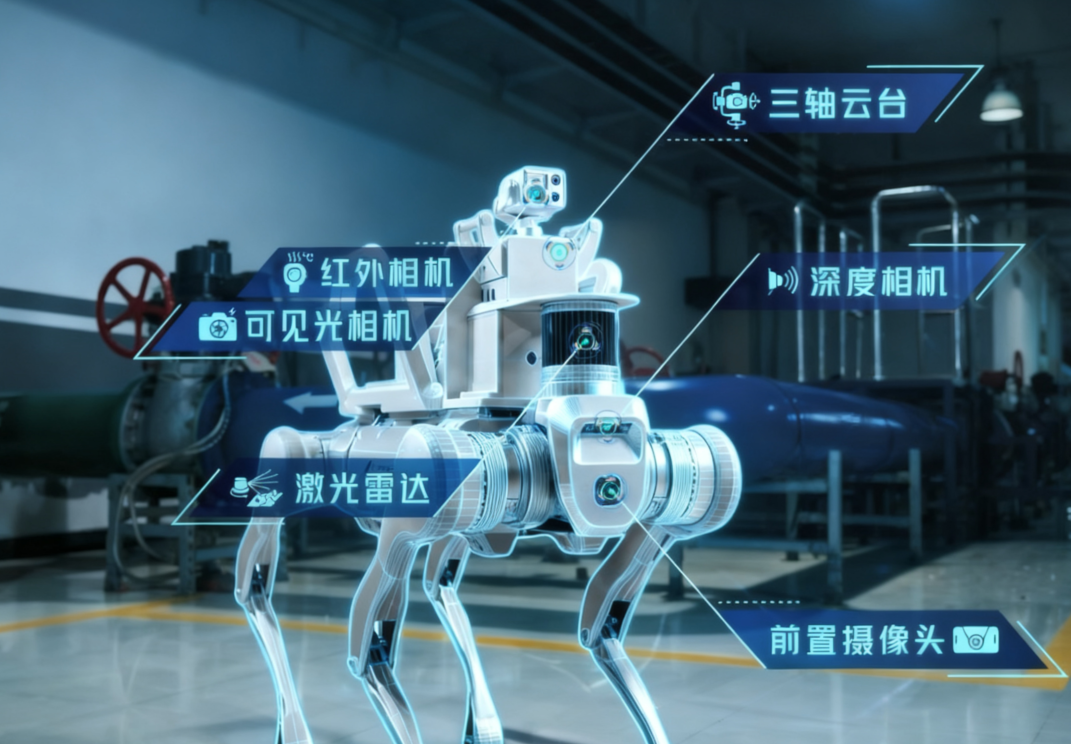
Its “eyes” — the OmniSight S4 four-spectrum pan-tilt-zoom (PTZ) camera — pierce the darkness. The visible-light lens records meter readings, while the infrared thermal imaging lens captures heat distribution. To the robot, frigid steel equipment is no inert matter but living entities emitting distinct thermal signals.
“Abnormal temperature detected on the bushing connector of Phase A of No.3 main transformer, with a temperature rise of 0.8°C.”
This is not a malfunction, but the robotic dog powered by the JX-Phi Physical AI Brain has caught this subtle shift with remarkable sensitivity. It aligns the frame of data with historical records across modalities within milliseconds. Supported by an algorithm accuracy rate of 87.7%, it confirms this spot carries potential risks.
Humans only see cold metal, whereas the robotic dog visualizes a dynamic thermal map where electric currents surge. Amid bitter cold, it safeguards the subtle thermal balance sustaining the power grid.
Never Lose My Way, Equipped with a Living Digital Map
Substations feature rugged terrain. Cable trenches, staircases and narrow gaps between equipment form an unstructured environment typical of industrial sites.
Humans navigate by instinct, while the robotic dog relies on full-domain autonomy.
Up ahead lies a stretch of ice-covered steps, an impassable barrier for conventional wheeled robots. The robotic dog’s four limbs grip the icy surface steadily; its core brain performs real-time environmental self-perception and dynamic decision-making.
No remote control or pre-installed magnetic tracks are required. Enabled by JX-Phi Brain, it comprehends its surroundings: calculating step heights, ice friction coefficients, and pinpointing optimal footholds instantaneously. Within its digital cognition, the entire substation is reconstructed into a high-precision 3D semantic map, with coordinates marked for every device and inch of ground.
“Route planned. Obstacle crossing initiated.”
Read Meters and Detect Abnormal Acoustics Alike
Patrols entail more than visual checks; they also rely on audio collection and physical sensing.
The robotic dog halts in the equipment zone. Its acoustic sensor gathers operational sounds emitted by the transformer. To human ears, only monotonous electrical buzzing can be heard, yet under the robot’s multimodal fusion perception, the sound is decomposed into frequency, amplitude and waveform.
It hunts for specific frequency signatures characteristic of partial discharge. Meanwhile, its “olfactory system” (gas sensor) screens for trace volatile gases released by insulating oil.
This capability of aggregating multi-source data allows the robot to capture multi-dimensional physical conditions via visible light, infrared, LiDAR point clouds, acoustic fingerprints and vibration signals. Comparable to a general practitioner, it conducts comprehensive physical examinations on equipment through integrated observation, listening and sensing. Upon identifying anomalies, it immediately triggers an emergency safety interlock mechanism, transmitting alerts to the backend platform to eliminate hidden dangers at the earliest stage.
My Mission Is Not Merely a Pass-Through Inspection, But Thorough, High-Quality Completion
Many assume inspection robots simply cruise the premises and snap photos. For JX Intelligence’s robotic dog, this is only the starting point.
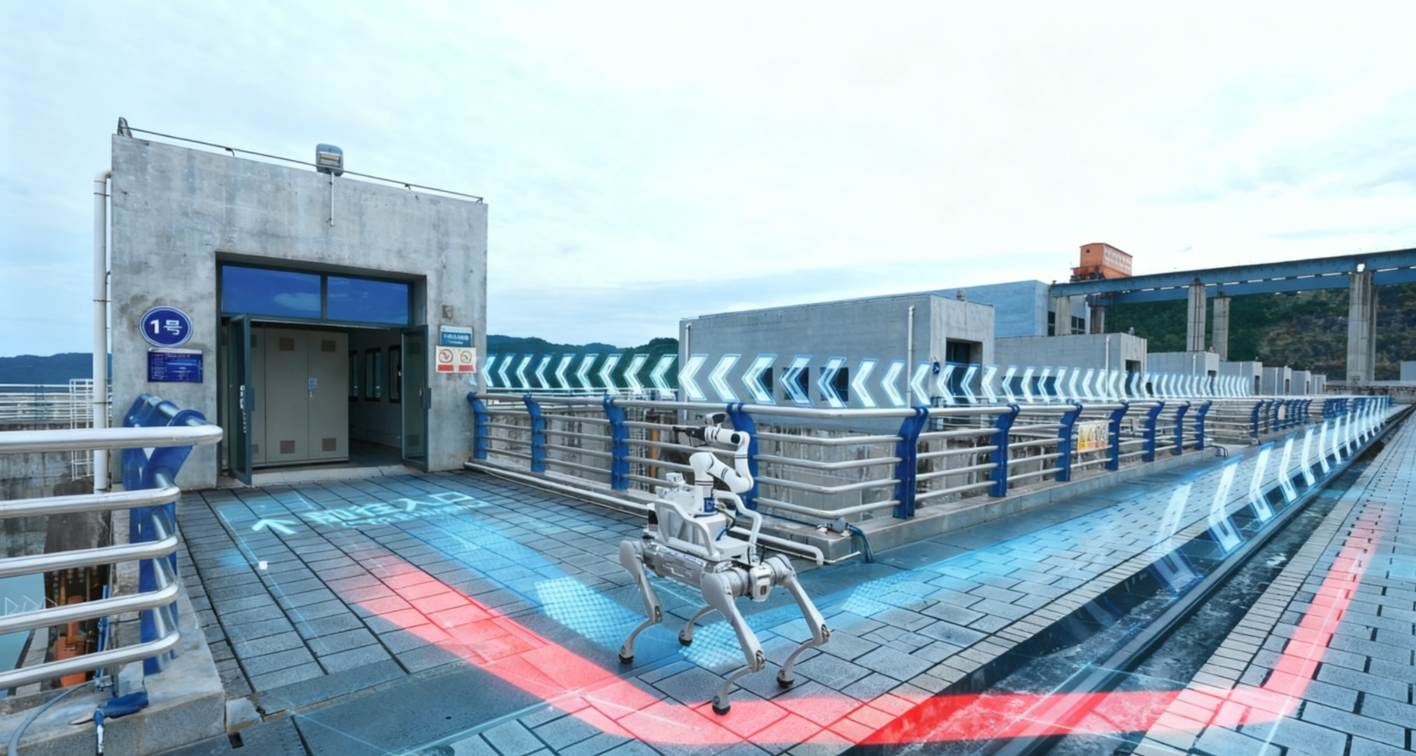
It executes long-task closed-loop operations. From entry to exit of the substation site, it completes dozens of predefined actions: reading hundreds of meters, identifying the open/closed status of dozens of disconnecting switches, and checking equipment surfaces for foreign objects.
The closed-loop mechanism matters most. When it spotted the overheating connector, its task did not end there. It automatically adjusts the PTZ angle and zooms in for secondary verification, uploading data to the cloud for spatiotemporal status analysis. If the abnormality is verified, it continuously tracks the trending changes of the target point until receiving follow-up instructions from the backend system.
Supported by task intelligence, the robot supports continuous planning with over 50 steps, guaranteeing precise execution throughout lengthy workflows with an average success rate of 95%.
Do Not Operate Alone; I Am Part of the One-Brain-Multi-Body System
While the robotic dog conducts its patrol hundreds of kilometers away, real-time footage, collected data and analyzed early warnings refresh synchronously on large screens at the remote command center.
This robotic dog does not function in isolation. It serves as one node within JX Intelligence’s One-Brain-Multi-Body strategy.
Its core brain, JX-Phi Brain, resides not only inside the robot body but also extends to the cloud. Powered by the AutoEdge edge-cloud collaborative engine, field robot data accumulated on-site converges with simulation data and real industrial operational data to fuel the iterative data flywheel of JX-Phi World.
Every successful obstacle traversal and accurate identification makes this robotic dog smarter, as well as its counterparts deployed at power stations nationwide. All terminals share one unified brain and consistent knowledge base.
Epilogue: The Cold and Warmth of Physical AI
Minus 20°C stands for the harshness of the natural environment, as well as the rational precision of Physical AI technology.
The robotic dog feels no cold or fear. Tirelessly traversing the frigid night, it dispels darkness with algorithms and safeguards power supply with data.
It may possess no subjective consciousness, yet its actions embody JX Intelligence’s mission: enabling Physical AI to deliver reliable execution in the physical world.
When the first sunlight of dawn falls on substation frameworks, the robotic dog finishes its mission and returns quietly to its charging booth. Behind it lies the stably operating power grid and peaceful slumbers of thousands of households.
This is the genuine “thought process” of the robotic dog operating inside the substation at minus 20°C.
Note
The JX-Phi Physical AI technology system, multimodal perception capability and other technologies mentioned in this article are fully self-developed by JX Intelligence.
To date, JX Intelligence’s solutions have been deployed across more than 1,500 industrial stations, covering key sectors including power grids, new energy, oil & gas, and chemical engineering. The company strives to become a leader in large-scale Physical AI commercial adoption.