

The Divergent Path of Physical AI and General Large Models: The Necessity Beyond GPT for Industrial Implementation
The Fork in the Road Between Physical AI and General Large Language Models: Why GPT Alone Cannot Meet Industrial Demands
General large language models are reshaping how humans interact with information. However, when AI needs to be deployed in electrical substations, photovoltaic power stations, coal mine roadways and chemical plant zones, a fundamental question arises: Can an AI built for conversation replace an AI built for hands-on industrial work?
The answer is negative.
Industrial scenarios are steering AI onto a technological path vastly different from that of general large language models. This is not a dispute over technical routes, but an inevitable divergence as AI evolves from perceiving the world to acting upon the physical world.
Two Distinct Paths: Comprehending Language vs. Comprehending the Physical World
The core competency of general large language models lies in language comprehension and generation. Trained on massive text corpora, they master conversation, writing, coding and logical reasoning. Essentially, they process information within a symbolic digital realm.
Physical AI addresses an entirely different set of challenges: understanding the spatial structures, physical laws and dynamic changes of the real world, while enabling machinery to stably execute tasks amid complex environments.
Dr. Chen Long, Chief Technology Officer of Fundamental Models at Jiangxing Intelligence, highlighted a pivotal judgment in a public sharing session: “For consumer internet AI, mistakes lead to user churn; for industrial AI, mistakes trigger physical disasters.” This quote lays bare the essential divide between the two categories of AI.
Industrial scenarios require AI to possess four core capabilities absent from general large language models:
-
Full-domain AutonomyIndustrial environments feature open spaces and highly heterogeneous layouts. AI must independently perceive surroundings, break down tasks, and make dynamic decisions to complete path planning and field operations in unstructured sites with minimal human intervention.
-
Multi-modal FusionTexts and images alone are far from sufficient. Industrial AI integrates multi-dimensional physical data including visible light, infrared rays, LiDAR point clouds, acoustic signatures and vibration signals to accurately capture equipment conditions and on-site operational status.
-
Long-horizon Closed-loop ExecutionIndustrial operations follow long closed-loop workflows: inspection → identification → operation → review. Such tasks demand cross-temporal memory, multi-step forward planning, dynamic execution adjustment, and support for continuous planning of over 50 sequential steps.
-
Extreme RobustnessIndustrial sites allow an extremely low margin of error. AI must operate under rigid constraints set by industry regulations, equipped with intelligent risk early warning and safety cutoff mechanisms. The system task execution rate must remain stably above 99%.
Brain and Body: Physical AI Delivers a Full Perception-Comprehension-Decision-Execution Chain
General large language models are confined to the thinking stage, while Physical AI delivers a complete closed loop spanning perception all the way through physical execution.
Within the technical architecture of Physical AI, the brain layer interprets environments, parses tasks, identifies key objects, adapts to diverse robotic hardware bodies, and generates actionable plans. It consists of two core modules:
First, the Foundation Model, responsible for multi-modal perception, object-level recognition, generalization across hardware platforms, and long-sequence task execution.
Second, Harness, governing model invocation, result verification, multi-agent collaboration and compliance with industrial protocols. This architecture empowers the Brain with both the expressive power of foundational models and industrial-grade operational reliability, forming an upper-layer intelligent hub tailored to physical power station operations.
Notably, the brain design of Physical AI clearly differentiates on-site observation interfaces and continuous training carriers. The observation interfaces accept multi-modal inputs such as vision, infrared, point clouds, electrical signals, vibration, textual operational regulations and robot status data. The training carriers further abstract raw observational data into structured representations including spatial semantic weights, object state graphs and constraint graphs. This allows the model to learn based on structured physical semantics rather than pattern matching against unprocessed raw data streams.
This design philosophy underscores a key truth: Physical AI is not merely trained in laboratories; it is honed and perfected through real-world industrial field deployments.
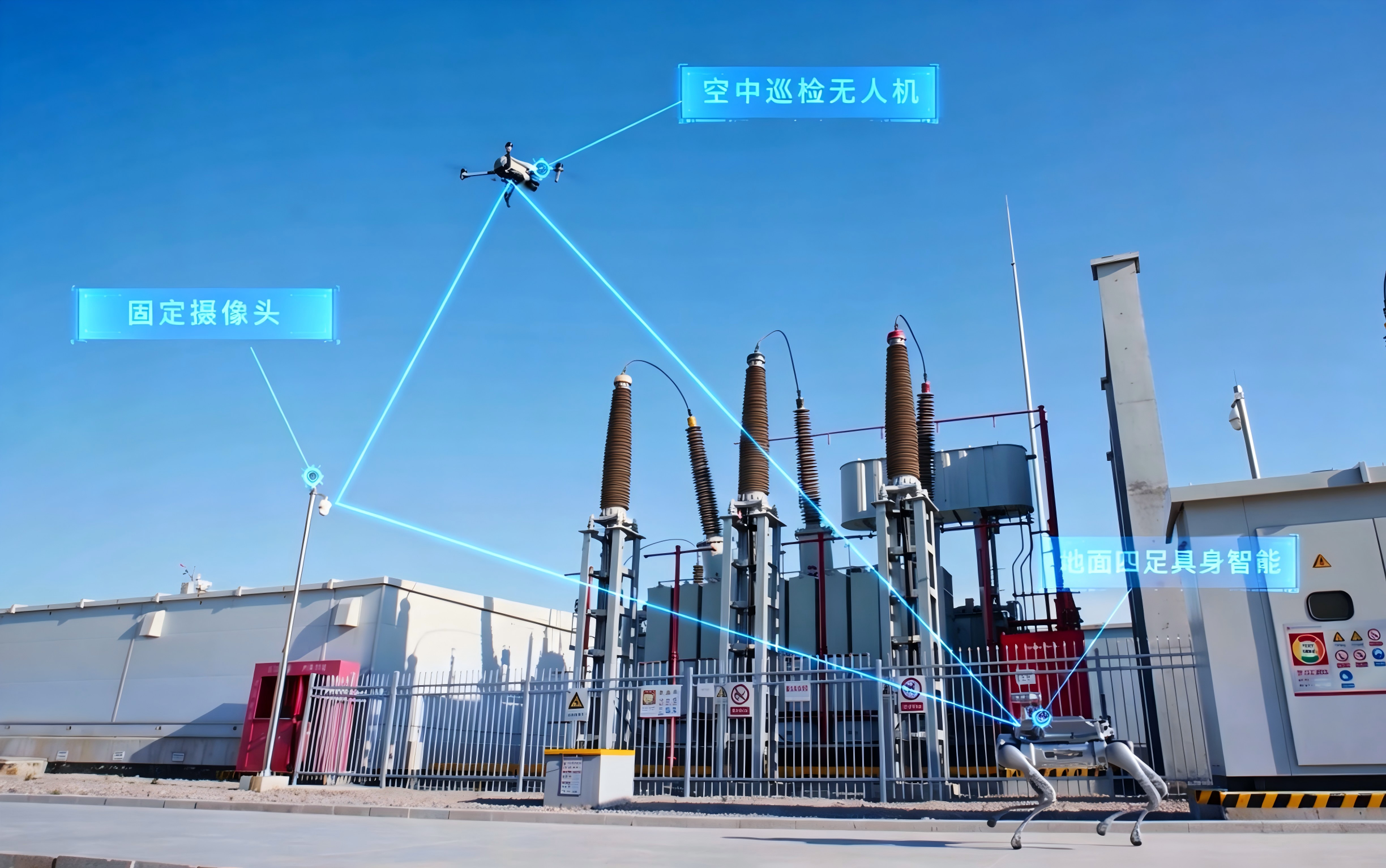
Building a Comprehensive Inspection Network Powered by the JX-Phi Physical AI Technology Ecosystem
Three-in-One Data Assets: The Data Source of Physical AI
General large language models draw data from online textual resources, while Physical AI sources data from the tangible physical world.
Jiangxing Intelligence has built a three-in-one data foundation covering Industrial Real Data, Edge Robot Data and Simulation Data:
- Industrial Real Data: Accumulated industrial know-how and model parameters derived from multi-modal field data;
- Edge Robot Data: Records of robotic motion trajectories, action sequences, manual takeover and anomaly recovery to solidify operational experience;
- Simulation Data: Generated based on real-world scenarios, 3D reconstruction, equipment specifications and physical constraints. Simulation data covers long-tail edge cases and enables zero-cost trial and error.
These three categories of data circulate continuously via two core infrastructures, AutoEdge and AutoWorld, forming a high-speed iterative loop: field data collection → model training → deployment verification → feedback optimization.
Reliability: Industrial AI Has No Room for Uncertainty
General large language models can respond with phrases like “I am not certain” or “Let me think again” during conversations, but industrial AI cannot afford such ambiguity.
A misjudgment at a power station may trigger large-scale blackouts; missed detection in chemical plants can spark safety incidents. This explains why Physical AI must embed robust constraint mechanisms aligned with industrial protocols.
Leveraging the industrial regulation module within the JX-Harness orchestration framework, Jiangxing Intelligence builds execution constraints with vertical industry expertise. The module manages overall task decomposition, model scheduling and safety emergency cutoff, ensuring all decisions translate into reliable physical control compliant with safety standards. This marks the fundamental distinction between Physical AI and general large language models: the latter prioritizes logically reasonable content generation, while the former prioritizes deterministic physical execution.
Two Paths, One Shared Future
General large language models and Physical AI are not mutually exclusive; instead, they complement each other. General LLMs excel at language processing and knowledge retrieval, while Physical AI specializes in spatial cognition and physical interaction. Future industrial systems will see synergy between the two: large language models provide human-computer interaction interfaces and knowledge query capabilities, whereas the Physical AI Brain handles on-site awareness, task execution and safety assurance.
One certainty remains: conversational-only AI can never replace AI capable of entering substations, climbing hills, navigating underground roadways, and running stable operations even in temperatures as low as minus 20 degrees Celsius.
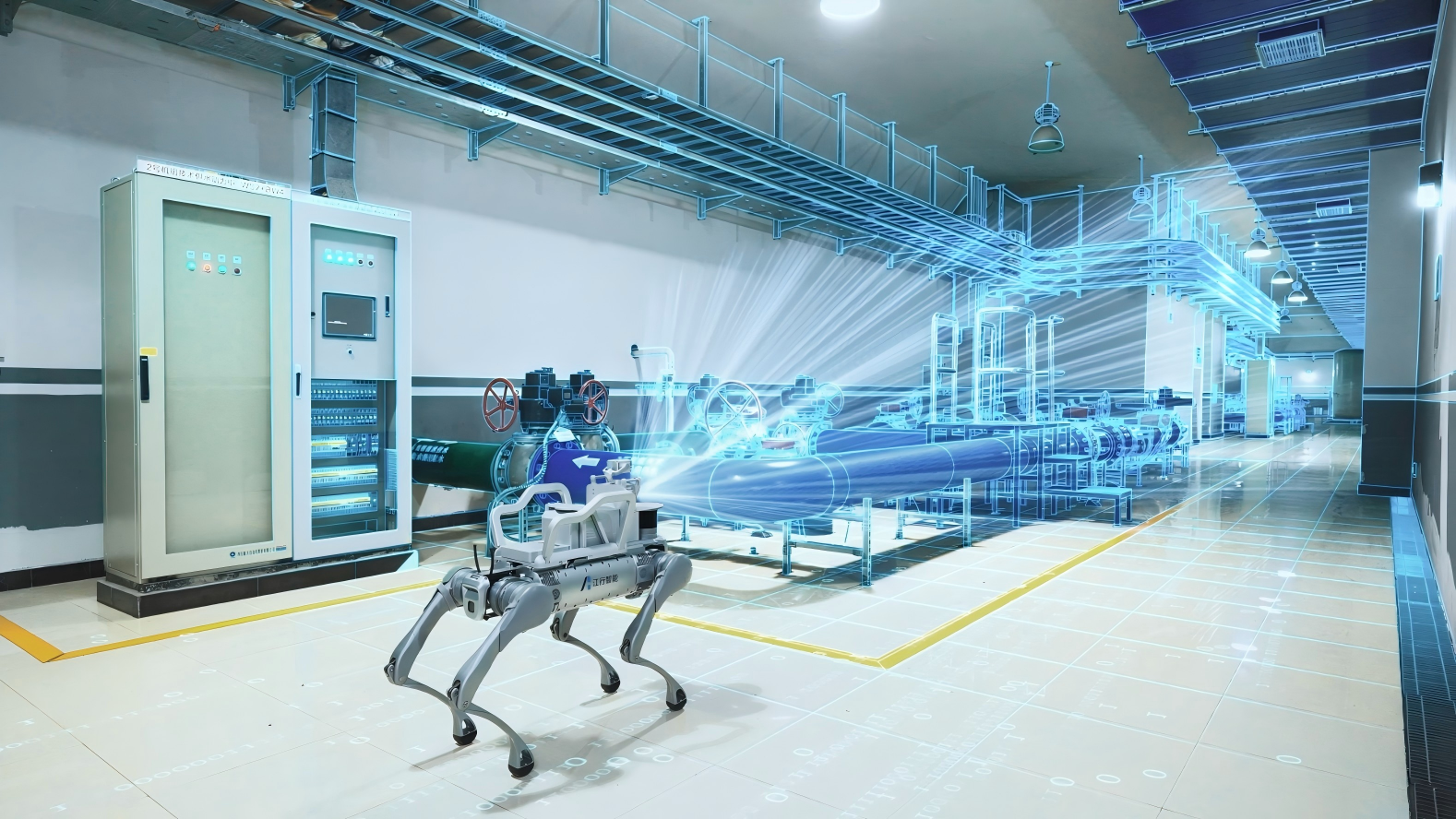
Robot Dogs Equipped with JX-Phi Brain Perform Autonomous Operations at Hydropower Stations
The ultimate goal of Physical AI is not to build models better at answering questions, but to deploy intelligent systems to industrial frontlines for stable task execution and sustained value creation.
The most critical industrial value of next-generation AI will no longer be confined to screens. It will manifest in tangible physical spaces, alongside real equipment, practical missions and tangible industrial productivity.