

The PV Power Station Welcomes an "Invisible Manager"
What Does a Truly Unattended Energy Station Look Like Today?
What should a genuine unattended operation scenario look like at modern energy stations?
It does not simply mean installing extra display screens or pushing surveillance feeds to mobile phones. Instead, it empowers the station to operate autonomously: drones take off automatically to inspect power poles; quadruped robots patrol equipment rooms to detect faults via sound; track robots travel along corridors to accurately read meter data. All visual data converges into a unified Physical AI core for real-time analysis, coordinated linkage and early warning.
JX Intelligence has recently completed on-site deployment of its solution at a large smart PV station.
One Core, Multiple Agents: A Unified Brain Governs the Full Air-Ground Equipment Suite
Traditionally, PV stations operate separate systems for video surveillance, drone inspection and manual patrol teams. These three isolated systems suffer fragmented data and poor cross-system coordination.
JX Intelligence seamlessly integrates the complete air-ground equipment suite via its JX-Phi Brain Physical AI core:
- Track Robots: Traverse indoor tracks in switch rooms and relay protection rooms. They pause to capture meter readings and verify the on/off status of circuit switches.
- Quadruped Robots: Access hard-to-reach outdoor zones including SVG areas, transformer bases and grounding transformers—locations inaccessible to vehicles. They collect acoustic signatures, measure surface temperatures and inspect equipment appearances.
- Drones: Conduct aerial inspections of power collection lines spanning dozens of kilometers. Flight routes are auto-planned to identify defects such as broken wire strands and damaged insulators.
- Fixed Camera Arrays: Monitor critical equipment including main transformers, GIS units and outgoing line terminals around the clock, combining infrared thermal imaging and visible light imaging.
All four types of inspection equipment share the same AI core. Once an abnormality is detected, the core automatically pinpoints its location, dispatches the nearest inspection device for secondary verification and issues alert notifications—all without human intervention.
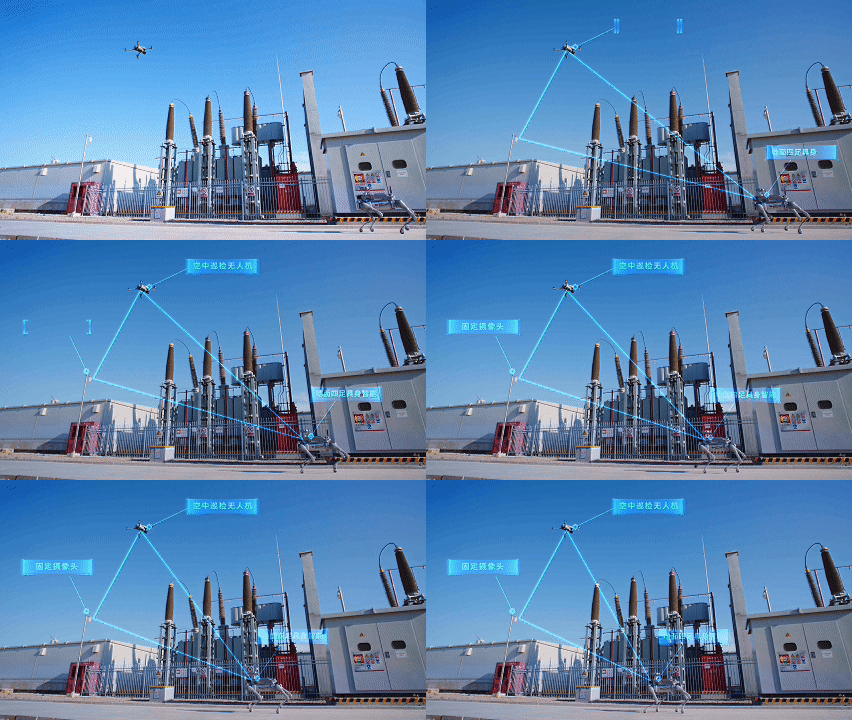
A full-dimensional inspection network built on the JX-Phi Physical AI technology system
Over 200 Perception Sensors Deliver Round-the-Clock Monitoring
How extensive is the coverage at this station? More than 200 intelligent sensing devices of varying specifications have been deployed across the site.
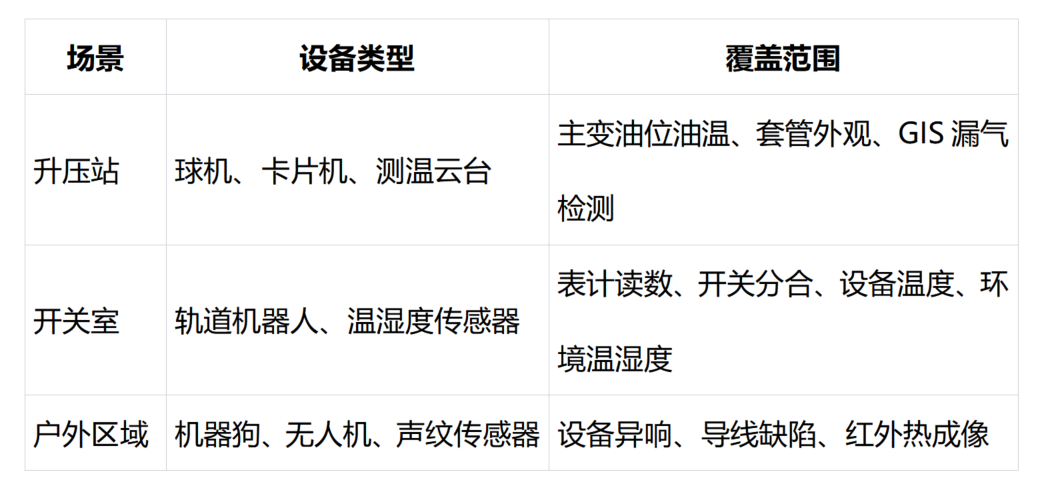
These sensors form a neural network covering the entire station, enabling real-time transmission, analysis and interpretation of all operational data.
AI Sees, Understands and Continuously Self-Learns
Embedded with dozens of AI algorithms, the system identifies not only equipment defects but also breaches of on-site safety protocols. It detects violations such as staff failing to wear safety harnesses, unauthorized line crossing, and prolonged loitering in hazardous zones.
Its standout capability lies in algorithm self-training. New AI models released by the group central control platform can be deployed on-site with one click. When the station encounters new types of faults during daily operation, corresponding samples can be added for supplementary training, making the AI core increasingly intelligent over time.
Every patrol mission serves as a training iteration for the AI brain.
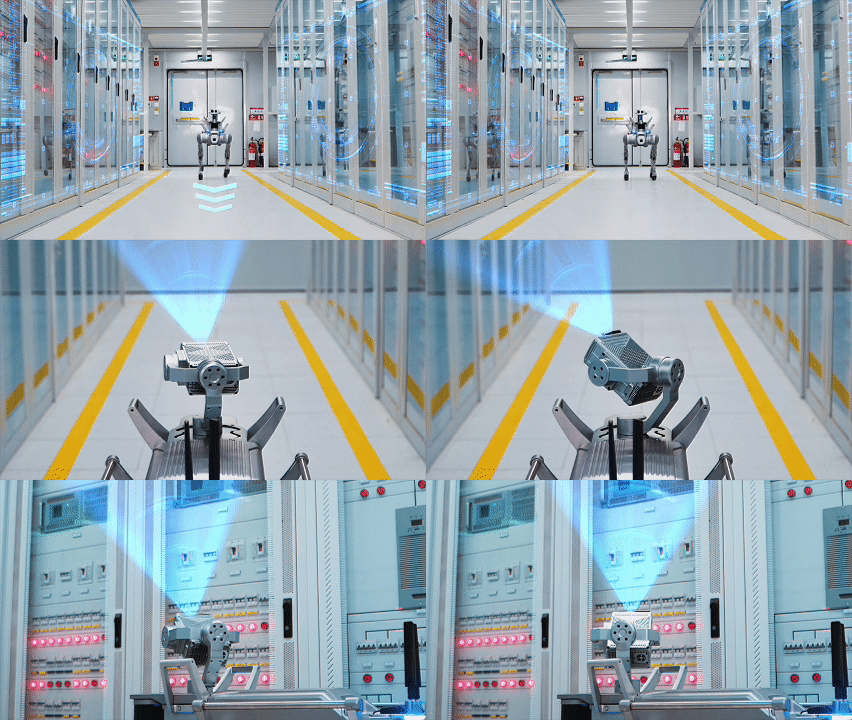
Quadruped robot equipped with JX-Phi Brain performing inspection tasks
Unattended Operation: Not a Concept, But Round-the-Clock Reliable Support
When people mention unattended operation, many picture futuristic sci-fi scenes. For real-world energy stations, however, it refers to a practical, robust engineering system running 24/7 nonstop.
From hardware installation and system joint debugging to upper-platform interconnection, the JX Intelligence team finished full-site delivery within three months: tracks laid, quadruped robots operational, drones flight-ready, and all AI algorithms fully functional.
This is not an isolated project. The identical one-core-multi-agent architecture has been deployed across 27 provinces and municipalities nationwide.
Unattended operation is no longer an unattainable vision. It is already a reality, quietly safeguarding unmanned stations day and night through the power of the Physical AI core.