

From Environmental Perception to World Transformation: Dr. Chen Long’s Inaugural Public Speech Decoding China’s Path to Industrial Physical AI
"The competition in AI has shifted from a race over model parameters in the digital realm to a contest of systematic capabilities in the physical world."
On May 25, Dr. Chen Long, CTO of Foundation Model at Jiangxing Intelligence, delivered a high-profile keynote speech titled From Environmental Perception to World Transformation: Opportunities, Paths and Challenges of Physical AI at an industry summit. This marked Dr. Chen’s first public appearance since officially joining Jiangxing Intelligence. Drawing on his profound academic background and frontline practical experience from ByteDance Volcengine, he systematically elaborated on the unique strengths of industrial Physical AI in China and Jiangxing Intelligence’s full-stack technological layout.
Below are the key highlights from the speech.
Core Judgement
AI Competition Is Shifting from Model Competition to Physical System Competition
Over the past few years, generative AI has fully demonstrated its value in the digital world, capable of content generation, code writing, intelligent Q&A and other tasks. For industrial enterprises, however, the real value frontier lies not behind screens, but in physical sites including wind farms, photovoltaic power stations, transformer substations, mines, chemical industrial parks and manufacturing workshops.
Dr. Chen clearly pointed out:
"When AI is deployed to industrial sites, competition no longer centres on model parameter scale or the accuracy of a single algorithm. Instead, the key lies in whether artificial intelligence can be deployed stably, safely and cost-effectively into the real physical world."
Industrial tasks are far more complex than simply identifying anomalies from a single image. They require end-to-end closed-loop workflows covering data collection, environmental understanding, equipment access, task planning, execution feedback and iterative optimisation. In this sense, Physical AI is not an isolated model, but a complete intelligent system designed for continuous on-site operation.
A top-tier scientist holding a PhD from Shanghai Jiao Tong University, a postdoctoral fellowship from Simon Fraser University and previous experience as a Senior Researcher at ByteDance, Dr. Chen boasts extensive industrial expertise in large-scale computing cluster management and the engineering implementation of foundation models. His insights stem from both cutting-edge academic research and first-hand industrial practice.
China’s Solution
Five-Tier Industrial Infrastructure Creates the Optimal Ecosystem for Physical AI
Why does industrial Physical AI enjoy the most favourable conditions for commercial adoption in China? Dr. Chen offered a systematic answer: China has built a replicable five-layer industrial foundation unmatched elsewhere across the globe.
Based on this multi-tier infrastructure, Dr. Chen summarised three structural opportunities for industrial Physical AI in China:
- Opportunities on the supply-side infrastructure: Continuous improvements in energy supply, communication networks, public infrastructure and edge computing nodes.
- Closed-loop opportunities on the on-site side: High-density industrial scenarios enable Physical AI to build a full data flywheel of deployment, data collection, model training, iteration and re-deployment.
- Efficiency-driven technical opportunities: Constraints on high-end chips have pushed the industry toward more efficient, low-cost and controllable technological pathways.
Jiangxing Intelligence is committed to integrating these combined advantages into deployable, replicable and iterable industrial Physical AI systems.
Core Technology
Jiangxing Intelligence’s Three-Tier Full-Stack Physical AI Model Architecture
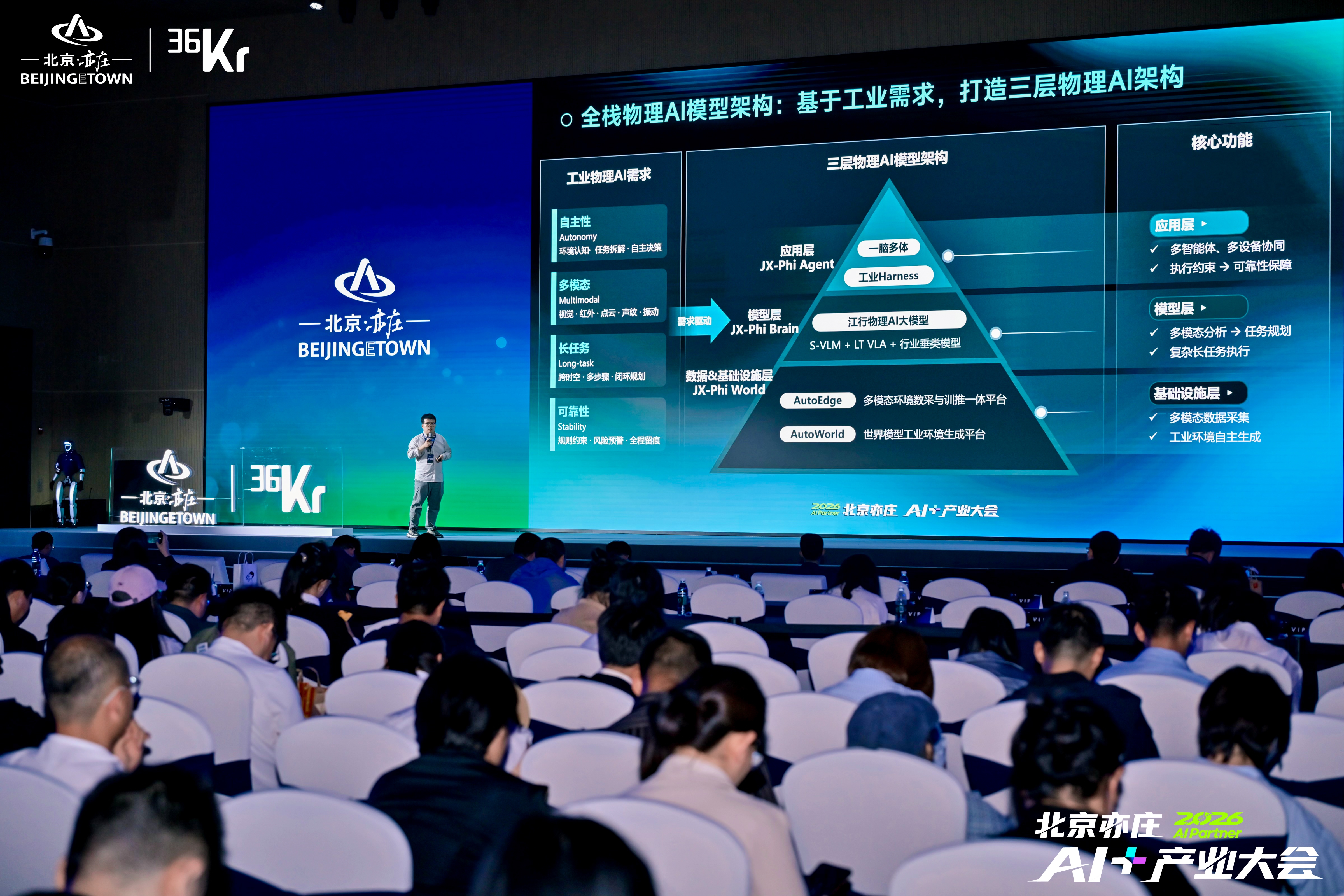
Challenges in industrial scenarios cannot be solved by a single standalone model. With this vision, Jiangxing Intelligence has developed a three-tier full-stack Physical AI architecture tailored for industrial applications, which stood as the technological highlight of Dr. Chen’s keynote.
Tier 1: JX-Phi World (Data & Infrastructure Layer)
Driven by dual engines of AutoEdge and AutoWorld:
- AutoEdge: Processes full-cycle industrial data sourced from sensors, thermal imaging devices, drone inspection systems and low-orbit satellite remote sensing equipment.
- AutoWorld: A world model simulation and data engine leveraging generative AI and 3D reconstruction to replicate rare and extreme operational scenarios. It allows AI to identify and fix errors in simulated environments prior to real-world deployment.
Tier 2: JX-Phi Brain (Model Layer)
Currently evolving into an industrial-oriented World Action Model (WAM) integrating three core capabilities:
- S-VLM (Spatial Vision-Language Model): Enables environmental perception and comprehension to support cross-modal reasoning and industrial scene modelling.
- LT-VLA (Long-Task Vision-Language-Action Model): Bridges perception and execution by decomposing complex industrial assignments into executable subtasks.
- Vertical Industry-Specific Models: Embeds domain expertise for power, chemical, mining and other sectors, supporting regular data collection across over 1,000 industrial stations and monitoring points to date.
Tier 3: JX-Phi Agent (Application Layer)
Powered by two core technologies: industrial Harness and the One-Brain Multi-Agent control framework.
- Industrial Harness: Restricts model operations within industrial procedures and safety boundaries, enabling automatic compliance checks and expert manual review.
- One-Brain Multi-Agent: A 100B-parameter global master controller that connects diverse terminal devices including inspection drones, quadruped robots, wheeled robots, fixed cameras, sensors and robotic arms.
Dr. Chen stressed: "A routine task such as equipment meter reading inspection by a quadruped robot typically needs to be split into 100 to 200 subtasks in industrial scenarios, with terrain, weather and other environmental factors fully taken into account." This stringent requirement fundamentally differentiates industrial Physical AI from consumer-grade AI and underpins Jiangxing Intelligence’s core technological moat.
Practical Deployment Validation
Technical Reliability Verified Across More Than 500 Substations and 600 Industrial Sites
The true measure of technological strength lies in real-world deployment results.
In the new energy sector, Jiangxing Intelligence’s Physical AI operation and maintenance system for wind and photovoltaic stations has been validated across over 600 station clusters nationwide, delivering 24/7 all-weather intelligent inspection. A full manual inspection of a large power station traditionally takes more than 30 days, while the Physical AI system completes the same task in merely two days.
Within the power grid industry, the company’s intelligent inspection system has been deployed in 27 provincial regions under State Grid and China Southern Power Grid, covering over 500 scenarios with a core algorithm accuracy rate of 99% and an average accuracy rate of 96%.
Particularly noteworthy is Jiangxing’s quadruped robot equipped with a robotic manipulator, which autonomously performs tasks including meter box access, equipment reading collection and basic voltage regulation. It is ideal for narrow spaces and high-risk zones inaccessible to human workers. Embedded with an 8B-parameter edge inference model, the robot leverages edge and cloud computing to deliver high-precision, low-latency operational performance.
Conclusion
From Environmental Perception to World Transformation
Dr. Chen Long’s official appointment as CTO of Foundation Model marks a new strategic phase for Jiangxing Intelligence in foundational large model research and development. Having transitioned from a special advisor to a core leadership member and moved from ByteDance to Jiangxing Intelligence, he adheres firmly to the vision that Physical AI must be grounded in real industrial sites, and now oversees the company’s foundational model technology roadmap, underlying computing infrastructure and architectural iteration.
As he concluded in his speech:
"The next wave of industrial value created by AI will no longer be confined to digital screens. It will be embodied in physical spaces, hardware devices, operational tasks and tangible productivity gains."
Jiangxing Intelligence aims to collaborate with industrial partners to bring Physical AI into real-world industrial scenarios. Starting with environmental perception, the company empowers the industrial sector to embrace intelligent transformation and reshape the physical world.
[Image]
About Dr. Chen Long
Dr. Chen Long holds a PhD in Computer Science from Shanghai Jiao Tong University and completed his postdoctoral research at Simon Fraser University. Previously a Senior Researcher at ByteDance, he participated in the architectural design of Volcengine’s large foundation models. He has published more than 30 CCF Class A papers and over 20 IEEE/ACM Transactions papers, winning Best Paper Awards twice at top international conferences in parallel and distributed systems. He officially joined Jiangxing Intelligence in May 2026 as CTO of Foundation Model.
About Jiangxing Intelligence
Founded in 2018, Jiangxing Intelligence is a national-level "Little Giant" specialised and sophisticated enterprise specialising in the R&D and industrial commercialisation of Physical AI technologies. The company has built a full-stack Physical AI technological ecosystem covering data infrastructure, cognitive foundation models and intelligent task execution systems. Its solutions have been widely deployed in energy, power and advanced manufacturing sectors, serving more than 1,000 industrial stations across the country.